First of all, a very quick history lesson. There have been two main schools of thought when it comes to teaching students how to read and write English: 1) the whole language approach, and 2) the structured literacy approach. The shortest version of this history is that the whole language approach has been the predominant method used in schools until recently. Recent research has revealed that many students are reading at a lower grade level than they should be, raising the question of whether students actually need a more structured approach. As we learn more about dyslexia and how students learn, it is becoming apparent that the structured literacy approach is a better fit for many students.
Most of us who are now adults were taught using the whole language approach , which was the most common way of teaching language arts from the 1970s through the 1990s. In this methodology, students are expected to learn words, based on context and cues. The idea behind this school of thought was a sort of osmosis: students were thirsty sponges who would learn to read if you just surrounded them with books. Let them read books with pictures so they can get the idea from the context. Provide silent reading time where they can choose whatever book they want, even if they can’t read it. Let them stumble over words and try to figure out the meaning; read aloud to them so that the meaning of the words will start to soak in. We call this a top-down approach. Students jump right into learning words, rather than starting with the individual sounds that combine to make them.
It makes sense, if you think of attaining reading skills as the same as attaining language skills. However, we now know that these two processes are very different! Children will learn their spoken language by being surrounded by native speakers. We’ve been speaking as long as we’ve been human!
Decoding written words, however, is a skill that has only been accessible to the everyday person for a few hundred years. Just because we’re surrounded by written words, not all of us can read them. It would be like expecting that someone who drives a car must automatically know how to repair it. Reading needs to be explicitly taught.
A structured literacy approach doesn’t leave children to struggle and try to figure it out on their own. It is a very intentional way of teaching that starts with making sure children understand that each letter has a name and a specific sound. Because we start with the building block sounds that make up words, we call this a bottom-up approach.
There has been a steadily growing body of evidence that many children, especially those with dyslexia or language-based learning differences, need the explicit, bottom-up structured literacy approach, in order to learn. The National Assessment of Educational Progress in the USA recently reported that only 33% of Grade 4 students and 31% of Grade 8 students were reading at or above their grade level. They believe that 95% of students would be able to reach their grade level, with a structured literacy approach.
Researchers now focus on the 5 Pillars of Reading, which they believe need to be taught for students to become skilled at reading and writing. These are phonics, phonemic awareness, comprehension, vocabulary and fluency. Orton-Gillingham incorporates all of these pillars.
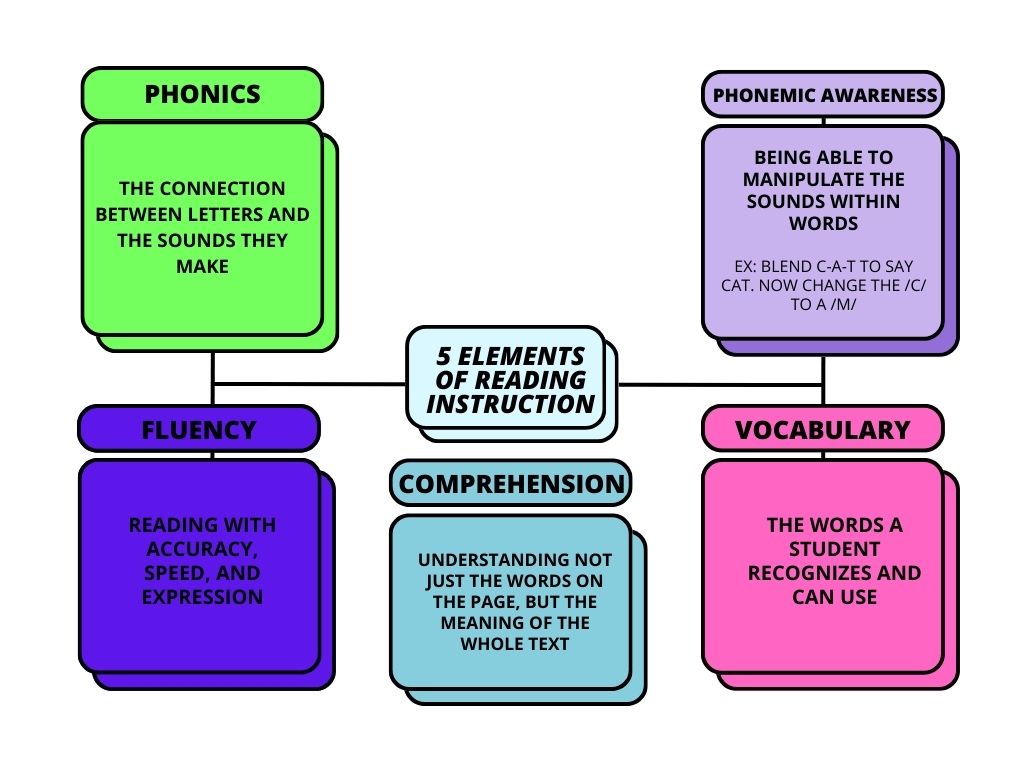
Teaching students the connection between letters and sounds is known as phonics.
We want them to be able to hear and manipulate the different sounds or phonemes in words: “take the word at and add a /k/ sound, what word do you have? Does cat rhyme with rot or rat? ” this is known as phonemic awareness.
Rather than relying on pictures or context clues, students are taught comprehension of words. They start to recognize common phonemes and understand how they’re combined. We also talk about the Latin, Greek and other roots of words. This systemic approach allows students to know, for example, why we spell music with a c but tick with a -ck. This increases their vocabulary, as well as their comfort level and fluency with English.
It’s harder to find Canadian stats, but here are some American websites to peruse for more info.
Stern Center for Language and Learning: https://sterncenter.org/whole-language-vs-structured-language-approach-to-teaching-reading/
https://www.nichd.nih.gov –National Institute of Child Health and Human Development (US Dept Health and Human Services) has published a quite intensive report on the five pillars: https://www.nichd.nih.gov/sites/default/files/publications/pubs/nrp/documents/report.pdf
 Orton Gillingham Tutoring